Testing APS-C Optics on 35mm Film
One of the key points to consider when selecting any camera system are the lenses available. This is important because the lenses tend to be the largest monetary investment in any system. You not only want good quality optics, but you also want lens systems that will be around for a while. Pentax is one of the few systems that allow users the ability to mount lenses, without adaptors, that date back to 1975 when the K-mount was introduced. The K-mount has not been ‘abandoned’ as other brands did with theirs, particularly as makers transitioned to auto-focus camera systems.
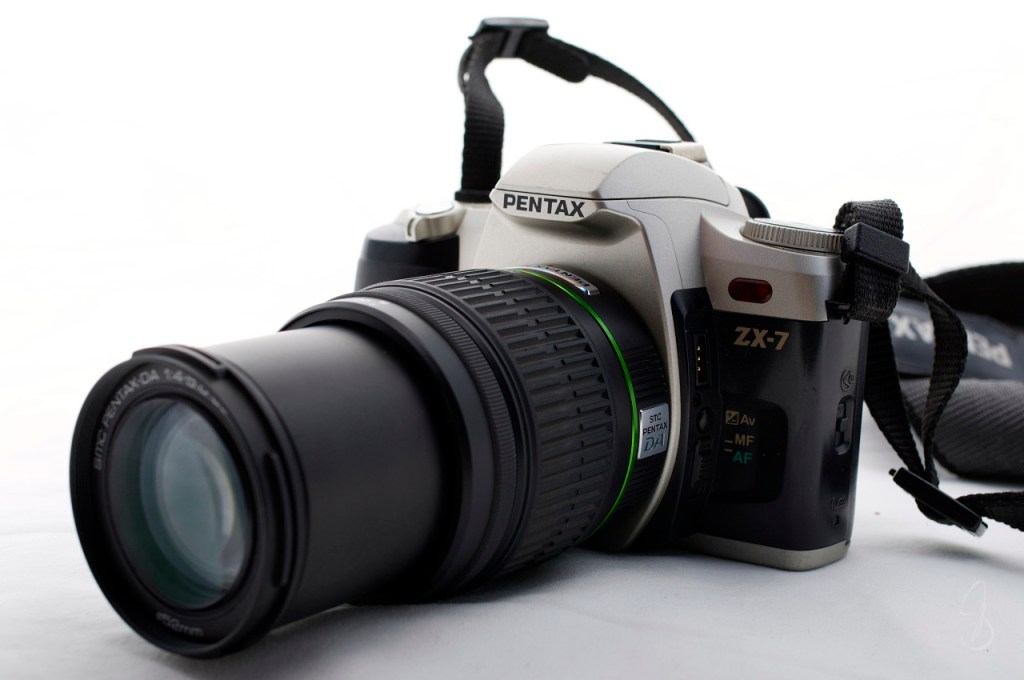
Pentax is also unique in that many new lenses can fully function on some Pentax film camera bodies. Granted, the new DA series lenses are designed specifically for covering an APS-C sized sensor and not a 35mm frame. Pentax has been very clear in stating this on their site and in their lens literature that APS spec lenses can cause severe light fall-off and vignetting when used on a 35mm camera. However, several lens designs (and this is true with other brands as well) have simply carried over from the film days. The DA 40mm f/2.8 Limited is one such lens for example.
I have the results of two lenses; the DA 16-45mm f/4 and the DA 50-200mm f/4-5.6. The DA 16-45mm f/4 works on film with fantastic results. Severe vignetting really only showing at focal-lengths below 24mm. Below 20mm it almost looks fish-eye like. But this behavior is understandable of such a wide angle on the larger format. You can see the results in these images. So once I got a hold of a DA 50-200mm I was curious to see how it would do.



First thing you notice is that vignetting is far more noticeable throughout the zoom range, it does add a distinctive character to images. Even at 50mm, you can see darkening in the corners like in the image of the old wheelbarrow. Zoom in to 200mm and vignetting increases as you can see in the images of the cats. While such vignetting would not typically be desirable for scenic landscapes; portraiture and detail shots benefit from the natural optical characteristic as it draws the viewer’s eye to the subject.




As for using these lenses on the ZX-7, it was a great pair. The lenses balance extremely well on the camera. Auto-focus performance was also speedy and sure footed. The two lenses combined, I have a seamless coverage from extreme wide-angle to moderate telephoto all with an almost constant f/4 aperture throughout.
I was hoping for performance similar to that of the DA 16-45mm in regards to vignetting with the DA 50-200mm. I hoped that the 50-100mm range would be relatively vignette free. Due to such poor performance in this regard, the DA 50-200mm would not be my everyday lens of choice on film. However, given its otherwise excellent performance and its unique look with the vignette, I would consider trying it again for a portrait session to see if I can put this lens in its real element.
Regardless of vignetting, the lenses produce some stunning results and go to show how flexible this system can be in providing a photographer creative options and optics that represent solid value and longevity.
 Photo-47
Leave a comment